Momentum Over Motivation: How Founders Keep Shipping When It Gets Hard
Shipping consistently beats waiting for inspiration. Here’s the framework solo founders use to stay productive and focused week after week.
Momentum Over Motivation: How Founders Keep Shipping When It Gets Hard
Introduction: The Post‑Launch Crash
Every builder hits it. You’ve shipped your MVP, maybe even landed a few users… and suddenly you’re tired, scattered, second‑guessing everything.
It’s not lack of talent - it’s lack of rhythm. Momentum is a system, not a feeling.
This post gives you a practical framework to keep shipping when it gets hard. You’ll break big goals into small wins, reflect fast without navel‑gazing, and protect your focus so progress compounds week after week.
Why Motivation Fails
Motivation is like caffeine - it spikes and fades. If your productivity depends on inspiration, your startup dies on bad days. Systems survive emotion.
Truths worth taping to your monitor:
- Feelings are lagging indicators. Output creates confidence, not the other way around.
- The brain rewards completion. Tiny finishes build momentum faster than giant, unfinished goals.
- Environments beat willpower. If your calendar, tools, and habits invite distraction, motivation won’t save you.
Your job isn’t to “get hyped.” Your job is to design a loop that still works when you’re not.
The Momentum Loop
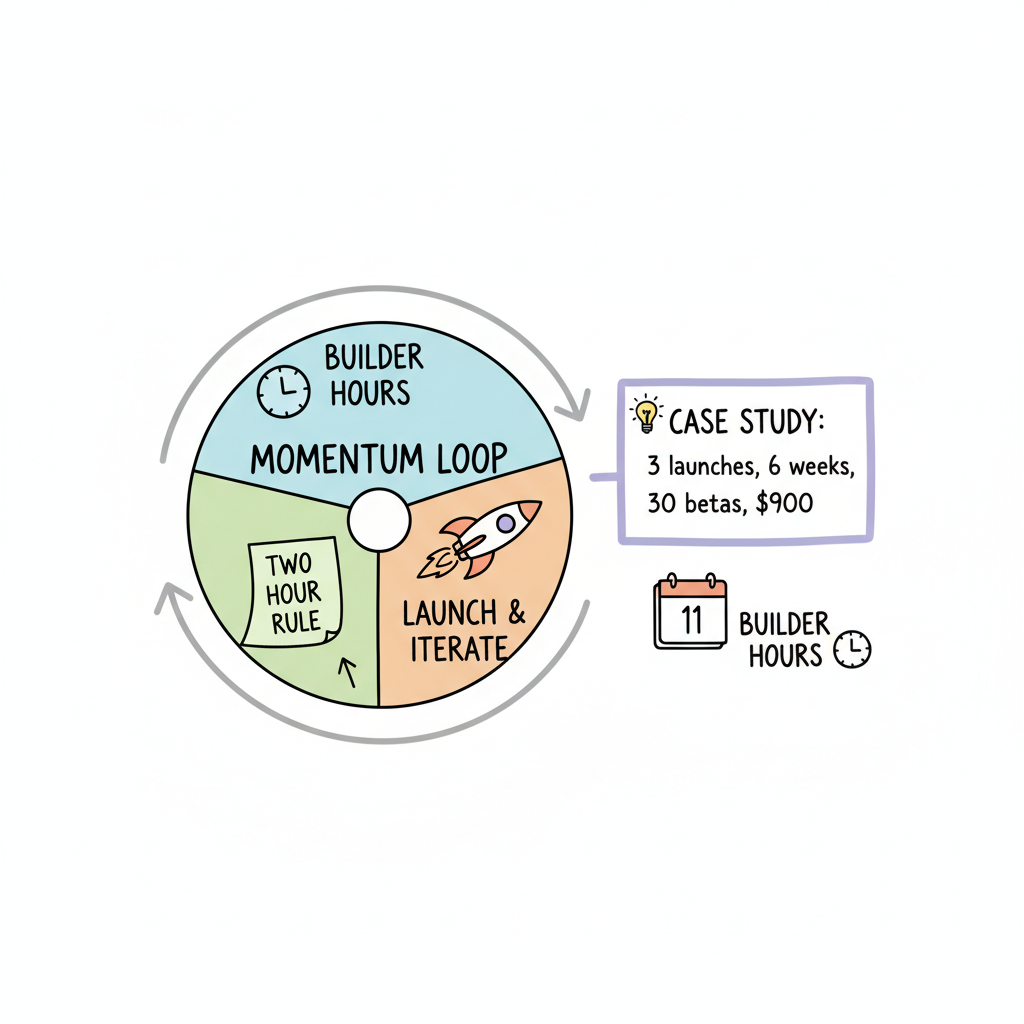
Think of momentum as a flywheel with three parts:
- Plan small → win early
- Reflect → adjust fast
- Protect focus → repeat daily
Each spin makes shipping easier. Most founders try to brute‑force motivation. Operators spin the loop.
Step 1 - Plan Small, Win Early
Break 14‑day goals into 2‑day deliverables. The smaller the unit, the higher the completion rate - and the faster your confidence rises.
Example 14‑day breakdown:
- Days 1–2 → Auth flow (sign up/in, session)
- Days 3–4 → Core UI polish (layout + typography + empty states)
- Days 5–6 → Analytics events (activation, completion, payment)
- Days 7–8 → Payments test flow (Stripe test mode)
- Days 9–10 → Integration (Slack webhook or basic import)
- Days 11–12 → Docs + README + demo script
- Days 13–14 → Deploy + demo + fix list
Use the Two‑Hour Rule: if it takes more than two hours to start, break it smaller. “Set up Stripe” is vague. “Create test product and fire payment_succeeded webhook to dev” is startable.
How to write 2‑day deliverables:
- Define “done” in one sentence: “User can upload a .csv and see a success message.”
- List 3–5 acceptance bullets. If you have ten, you’ve defined a project, not a deliverable.
- Decide tests upfront (manual is fine at MVP stage).
Thin‑slice examples by domain:
- Marketplace: “Seller can create a listing with title/price/photo; listing appears on list and detail.”
- Analytics: “Track
activatedandcompleted_core_flowwith IDs and durations; query works in a sheet.” - Ops tool: “User can create ticket → mark resolved; resolution time recorded.”
Why this works: small, definition‑of‑done tasks produce fast finish lines. Finish lines beat motivational speeches.
Step 2 - Reflect & Adjust Fast
End each day with three lines:
- What moved forward?
- What slowed me down?
- What to change tomorrow?
Ten minutes beats ten hours of regret later. You’re not writing a diary - you’re tuning the loop.
Reflection guidelines:
- Be brutally specific. “Meetings” didn’t block you; “Slack pings during 9–11am” did.
- Turn friction into a counter‑move. If context‑switching killed you, put two deep‑work blocks on the calendar tomorrow.
- Capture “next smallest step” while your brain is warm; tomorrow, you’ll just execute.
Weekly retro (30 minutes, Friday):
- One win to repeat
- One friction to remove
- One bet for next week (a tiny experiment)
That’s it. Reflection should fuel action, not become a hobby.
Step 3 - Protect Focus
Create “builder hours” - daily slots when no calls, no socials, no Slack. Consistency > duration. Even 90 focused minutes daily = 10+ productive hours per week.
How to defend builder hours:
- Block them on the calendar. Treat them like investor meetings.
- Close everything. Full‑screen editor. Phone in another room.
- Use a simple timer (25/5 or 50/10). The point isn’t the timer; it’s the boundary.
Environment tweaks that matter:
- Two desktops (or spaces): one for comms, one for build. Switch intentionally.
- Default to Do Not Disturb during builder hours.
- Keep a visible “Do Next” note so you start instantly after a break.
Signal to others:
- Add “Builder Hours 9–11” to your email signature/calendar status.
- Tell collaborators: “I batch replies at 11:30 and 4:30. Emergencies = text.”
Focus is not about monk‑mode. It’s about predictable, defended time where you always move the ball.
Tools That Help (Keep It Boring)
- Calendar blocking for builder hours and retros
- Pomodoro timer (any plain one)
- “Ship It” wall - a physical or digital log of shipped items (screenshots, short notes)
- Momentum tracker - a tiny weekly scoreboard (in the lead magnet below)
The best tool is the one you’ll actually use when you’re tired.
Case Study - A Solo Founder’s Rhythm
A solo founder built an AI résumé tool. Before: scattered sprints, burnout. After adopting a 7‑day momentum system:
- 2 hours daily deep work (9–11am builder hours)
- A 10‑minute daily reflection and 30‑minute Friday retro
- Three launches in six weeks (thin, focused releases)
Result: 30 beta users and $900 in pre‑sales within two months. No growth hacks - just consistent shipping.
What changed:
- Work units shrank to 2‑day deliverables with clear acceptance criteria
- Interruptions got batched; mornings went quiet
- Wins were visible, which refueled motivation automatically
Momentum Templates (Steal These)
Daily plan template (3 lines):
- One deliverable today (definition of done): …
- Two hazards to neutralize: …
- First 15 minutes: …
Daily reflection template (3 lines):
- Moved forward: …
- Slowed me: …
- Change tomorrow: …
Weekly retro (Friday):
- Repeat this win: …
- Remove this friction: …
- Try this tiny bet: …
2‑day deliverable checklist:
- Clear, verifiable outcome
- 3–5 acceptance bullets
- Startable in 15 minutes
- Demoable in 5 minutes
How This Ties to a 14‑Day MVP Sprint
Momentum isn’t separate from your product; it’s how you structure the work so a 14‑day demo is inevitable.
Mapping the loop to the sprint:
- Plan small → each 2‑day deliverable maps to a piece of the thin slice (auth, core flow, payments, analytics, integration, docs)
- Reflect → Day‑7 check‑in trims risk; Friday retro sets the final push
- Protect focus → builder hours ensure meaningful progress every day
When you stack two 14‑day sprints with this loop, you get compounding: Sprint 1 ships the thin slice; Sprint 2 tightens activation/completion/retention based on real data.
Handling Low Days Without Losing the Week
You will have days where the wheels wobble. Plan for them.
Protocol for a bad day:
- Cut the scope in half. Keep the promise by shrinking the deliverable.
- Do the smallest valuable step (write a failing test, scaffold a component, draft the README section). Finish something tiny.
- Protect tomorrow. End with a two‑line plan and a clear “first 15 minutes.”
Energy management beats heroics. The goal is never “perfect day”; it’s “no zero days.”
The Momentum Math (Why This Works)
Momentum compounds like interest. A single 90‑minute block yields a visible finish line. Visible finish lines reduce switching and avoidance. Reduced switching preserves cognitive energy. Preserved energy fuels the next block. Repeat.
Two hidden multipliers:
- Public commitments (to a collaborator or build log) nudge you over the line when motivation dips.
- Shipping creates external feedback, which sharpens scope and kills wasteful detours.
Instead of waiting to “feel like it,” you create small, inevitable wins that generate the feeling.
Common Founder Traps (And Fixes)
- Trying to “catch up” with a 14‑hour day → schedule two 90‑minute blocks and stop
- Planning in epics → write two‑day deliverables with acceptance criteria
- Letting comms bleed into build time → batch messages twice a day, set expectations
- Measuring hours instead of outcomes → track shipped items and demoable changes
- Over‑engineering the system → three templates, one calendar, one timer
The Momentum Planner (Lead Magnet)
A 7‑day Notion + PDF planner to:
- Break goals into small sprints
- Track daily focus sessions
- Log wins and lessons
- Review a weekly momentum score
👉 Download the Founder Momentum Planner.
Key Takeaway
Motivation is unreliable. Momentum is built. Small wins → quick reflection → consistent focus. When that loop spins, shipping becomes default behavior, not an act of willpower.
Start tomorrow with one 2‑day deliverable, one 90‑minute block, and a three‑line reflection. Spin the flywheel once. Then again.
CTA
Grab the Founder Momentum Planner and build a rhythm that ships even when you don’t feel like it.
Visit weekonelabs.com.
Building an MVP? Week One Labs ships custom-coded SaaS and mobile MVPs in fixed-price 14-day sprints. Book a free scope call to get a plan for your build.