What to Do After MVP Launch - 30 Day Playbook
Your MVP shipped - now what? I give you the exact 30-day post-MVP strategy: demos, user interviews, metrics, and Sprint 2 planning.
What to Do After Your MVP Ships: The 30‑Day Post‑Launch Playbook
You did it. You shipped your MVP. The deploy button is green, the URL works, the demo runs.
And then the founder panic sets in: “Okay… now what?”
Here’s the truth: an MVP isn’t an ending. It’s a conversation starter. The next 30 days matter more than the build itself. This post gives you a tactical, founder‑friendly playbook for what to do right after launch.
Section 1: Demo Like a Pro
Your MVP exists to be seen and touched. The first 10 demos you run are the most important.
- Keep it under 5 minutes.
- Always demo the happy path (not edge cases).
- Narrate the problem → action → outcome.
- End with the moment of value (payment, report, order, etc.).
👉 I built a Founder’s Demo Script you can steal. (Download link below.)
Section 2: Book 10 User Conversations
Don’t chase “sign‑ups.” Chase conversations.
- Reach out to your network (ex‑colleagues, Twitter followers, LinkedIn connections).
- Offer to walk them through in exchange for 15 minutes of feedback.
Ask:
- What problem were you trying to solve?
- What was hard or confusing?
- What would make this indispensable?
Record everything. Don’t defend, don’t pitch - just learn.
Section 3: Measure Like a Scientist
Define your success metric before launch. Examples:
- 10 sign‑ups, 7 completed flows, 2 payments.
- 5 real requests created and resolved.
- $100 in transactions.
Now track them in a simple dashboard. If you hit your metric → you have proof. If you don’t → you have direction.
Section 4: Write the Backlog (Sprint 2)
Every “nice to have” you ignored in Sprint 1? Parked in backlog.
Now:
- Prioritize based on user feedback.
- Sort into buckets: must fix, nice to have, stretch ideas.
- Commit to Sprint 2 only after user data confirms demand.
Section 5: Share in Public (Yes, Really)
Posting your MVP journey is not “giving away ideas.” It’s marketing.
- Share your demo clips.
- Share lessons you learned from the first 10 users.
- Share your metrics openly (“7 flows completed, 2 paid transactions”).
Founders, investors, and early adopters notice momentum.
Section 6: Decide the Path
After 30 days, ask:
- Do we iterate (users engaged)?
- Do we pivot (job was wrong)?
- Do we pause (data shows no pull)?
This is the hardest call - but a disciplined founder makes it with data, not ego.
Section 7: Founder Story Example
- I built a transcript‑to‑report MVP.
- Demoed to 6 coaches.
- 2 pilots signed up.
- $300 in Stripe transactions in the first month.
- Backlog: integrations with Zoom + Notion.
That’s enough proof to go Sprint 2. Without the MVP, I’d still be guessing.
Section 8: The Founder’s Demo Script (Lead Magnet)
I built a simple 5‑minute demo script template:
- Problem → flow → value → CTA.
- Fill‑in‑the‑blank structure so you never ramble.
- Perfect for customer calls or investor pitches.
Key Takeaway
An MVP is a starting line, not a finish line.
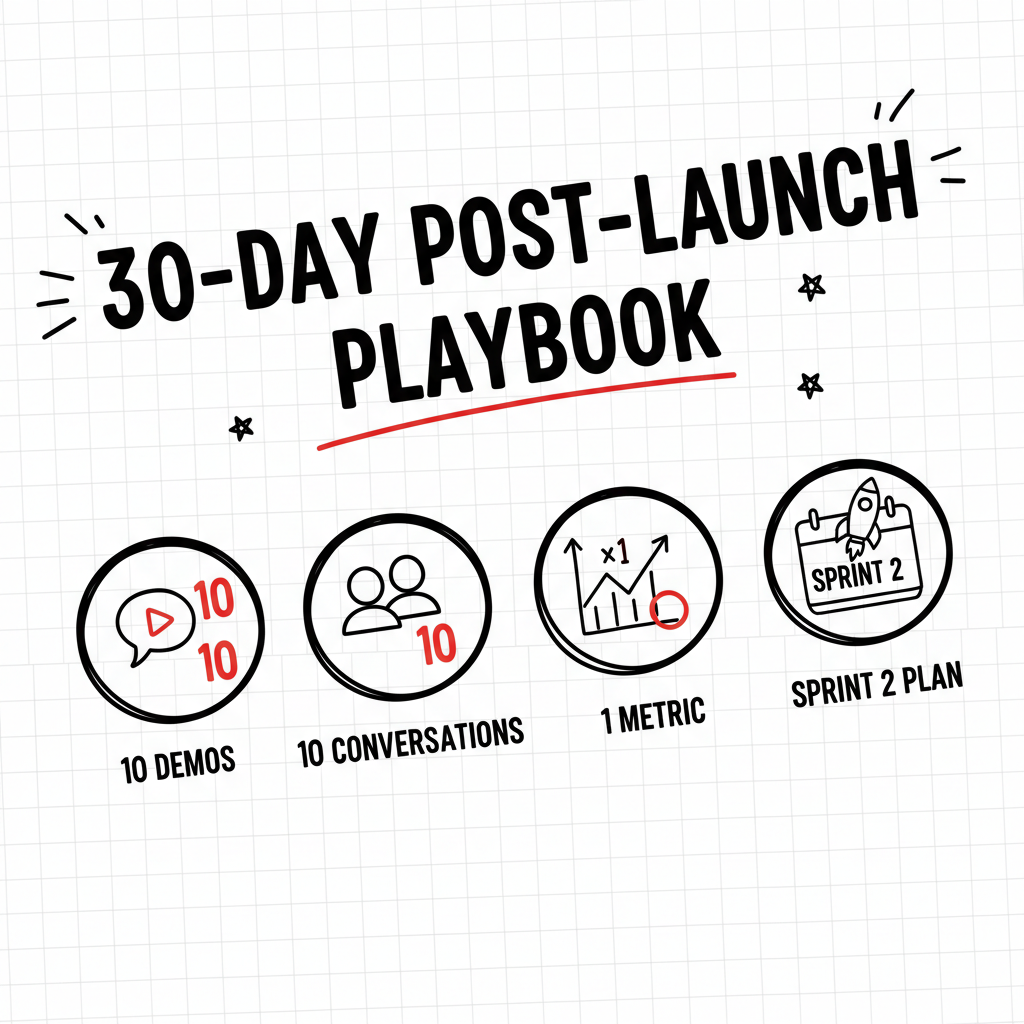
Your next 30 days = demos + conversations + metrics + backlog.
Do that, and you’ll know whether to double down or change course.
CTA
If you’ve shipped (or want to), grab the Founder’s Demo Script and book a 20‑min scope call to plan Sprint 2.
weekonelabs.com
Building an MVP? Week One Labs ships custom-coded SaaS and mobile MVPs in fixed-price 14-day sprints. Book a free scope call to get a plan for your build.