How to Choose Startup Idea - MVP Validation Framework
Too many ideas, no idea which to build? I show you how to pick and validate the right startup idea to MVP in 14 days.
How to Choose the Right MVP Idea (and Avoid 6 Months of Wasted Work)
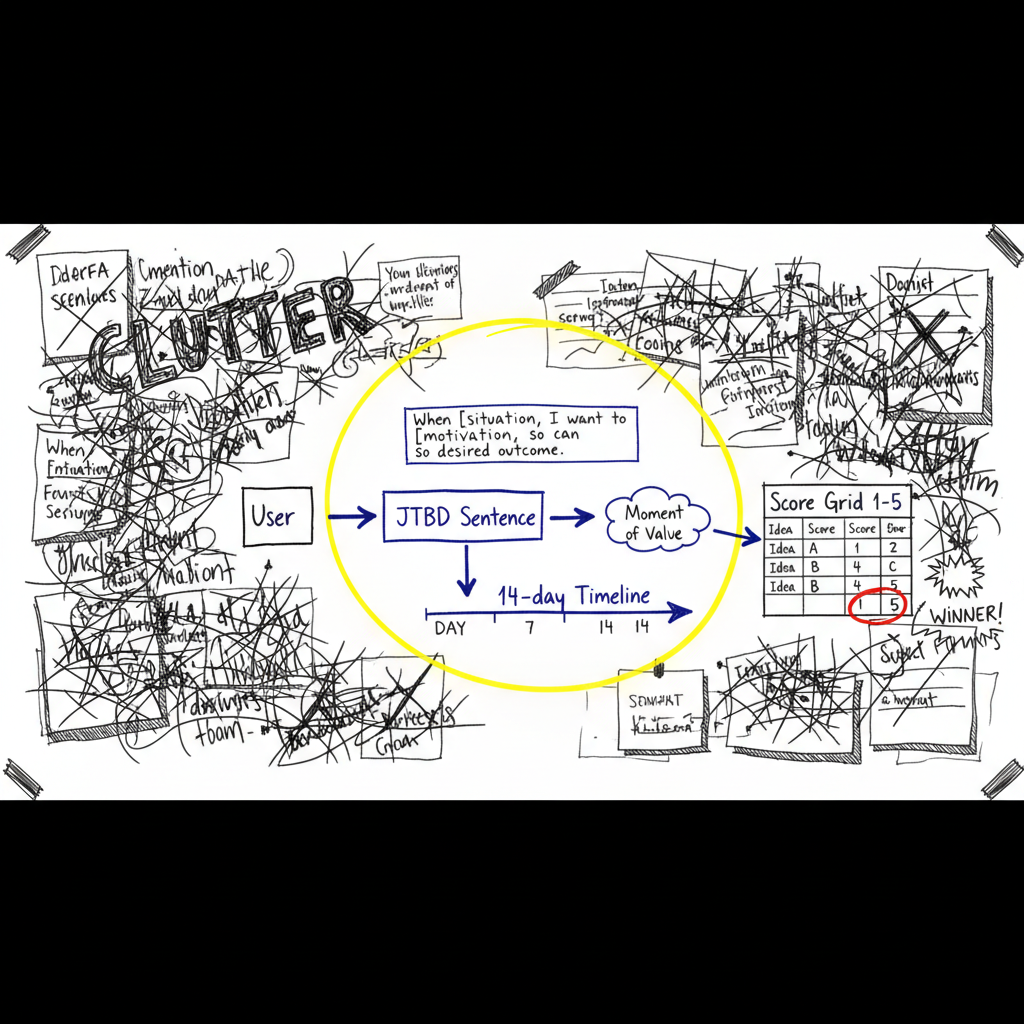
Most founders don’t fail because they have no ideas. They fail because they have too many.
Here’s what I see all the time:
- A Notion page with 20+ product ideas.
- Whiteboard sketches everywhere.
- A cofounder Slack channel full of “what if”s.
Six months later? Nothing shipped. That’s wasted time, energy, and money. And the worst part: the market has moved on.
In this post, I’ll show you how to pick one idea worth building into a 14-day MVP. You’ll learn my MVP Idea Filter - a simple worksheet you can fill out in under an hour to rank your ideas. At the end, I’ll share it with you as a free download.
Why “biggest TAM” is the wrong filter
Most founders default to: “Which market is biggest?”
The problem: chasing TAM leads to abstract opportunities with no anchor.
- “Healthtech is huge, let’s do something there.”
- “AI in education is going to be massive, we should build something.”
Reality check: markets don’t buy products - users do. And unless you know a user deeply, your giant TAM is just a giant trap.
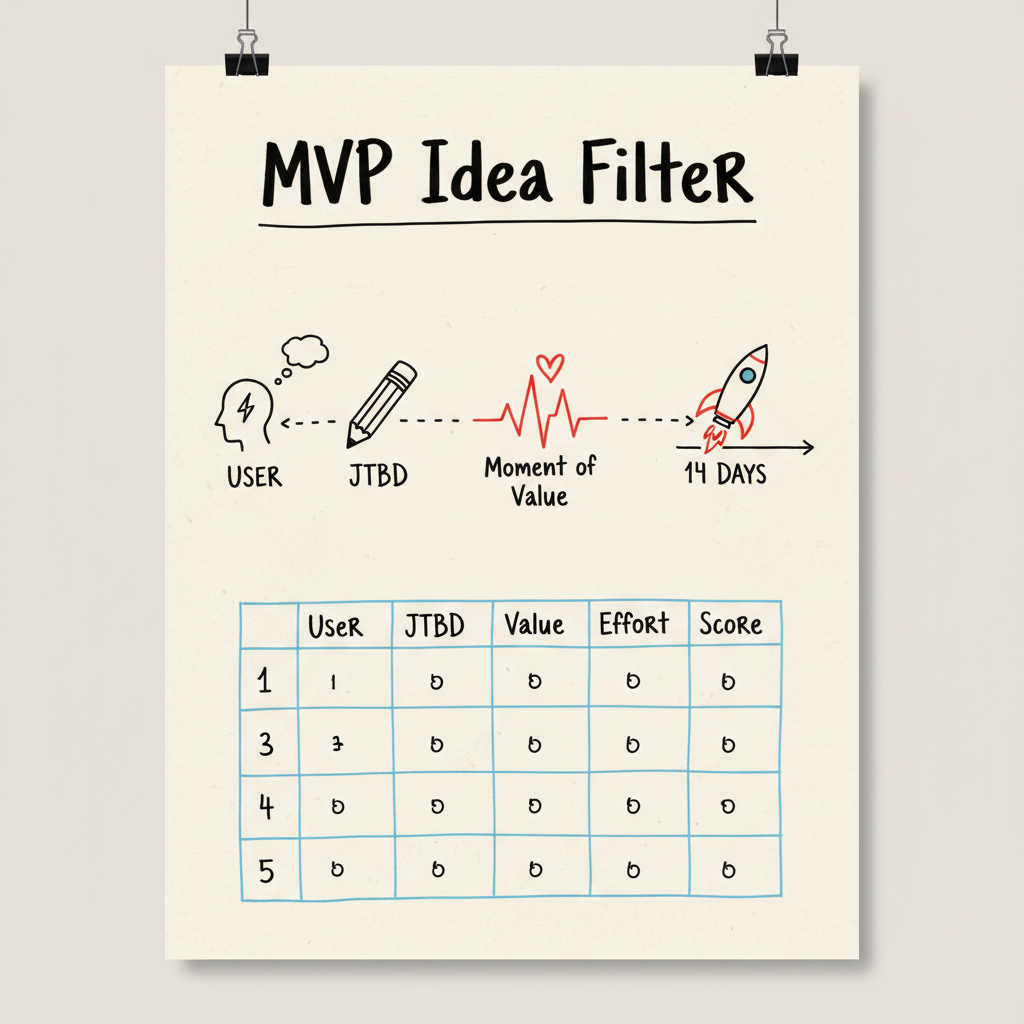
👉 Rule 1 of the MVP Idea Filter: start with the user you know best.
How to Define the User
Ask yourself:
- Who do I already understand?
- Who do I already have access to?
- Whose problems do I feel in my bones?
Examples:
- If you used to work in logistics → your user might be warehouse managers.
- If you’ve been freelancing in marketing → your user might be small e‑commerce founders.
Don’t pick a stranger. Pick someone you can interview tomorrow.
Write the Job‑to‑Be‑Done
Every MVP idea must be reducible to a single sentence:
“When [situation], the user [does this] to get [desired outcome].”
Examples:
- “When a tenant reports a leak, a property manager assigns it so it gets resolved and billed.”
- “When a coach runs a session, they want automated notes so they can focus on clients.”
- “When a small shop runs out of stock, they want a reorder button so they don’t lose sales.”
If you can’t write your idea like this, it’s not ready to build.
The Moment of Value
The biggest mistake in MVP scoping: building features without knowing what proves success.
Ask: what’s the one moment that shows the product works?
- A successful payment
- A file generated and downloaded
- A task created and marked complete
- A ticket resolved
This is the heartbeat of your MVP. Your sprint races to this moment - and nothing else.
The Thin Slice Test
Here’s my golden rule:
If you can’t build the happy path (auth → one core flow → payments/analytics → deploy) in 14 days, it’s not an MVP idea. It’s a roadmap.
So:
- If your idea requires 12 different user types on Day 1 → fail.
- If it requires heavy AI infra before first demo → fail.
- If it’s “auth → create → complete → pay” → pass.
Thin slice = the test of feasibility.
Feedback Loops
A good MVP doesn’t just ship fast. It teaches you fast.
Ask:
- Can I learn something in 30 days after launch?
- Can I measure usage, not just collect opinions?
- Will users either pay, or at least complete flows?
If the answer is “we’ll know in 12 months” → that’s a research project, not an MVP.
Scoring Your Ideas
At this point, you’ve got four criteria:
- Do I know the user?
- Can I write the job in one sentence?
- Is there a clear moment of value?
- Can it thin‑slice into 14 days + fast feedback?
Score each idea 1–5. The one with the highest score is your MVP.
A Worked Example
Founder has 3 ideas:
- B2B marketplace for spare auto parts
- AI tool that turns Zoom transcripts into action plans
- Meal‑sharing app for home cooks
Scoring:
- User familiarity: knows ops managers best → #2
- JTBD clarity: “turn transcripts into usable docs” → #2
- Moment of value: “report generated” → #2
- Thin slice: upload → generate → download → deploy → #2
👉 Winner: AI transcript tool.
What to Do After You Choose
Once you’ve picked your idea:
- Fill the backlog with everything else (no guilt).
- Build only the thin slice.
- Commit to a Day‑14 demo no matter what.
By forcing yourself to choose, you unlock momentum.
The MVP Idea Filter Worksheet (Lead Magnet)
I created a one‑page worksheet where you:
- List 3 ideas
- Score them against the 4 filters
- Pick a winner
It takes 30 minutes, and you’ll know exactly what to build.
👉 Download the free MVP Idea Filter Worksheet
Key Takeaway
The best MVP idea isn’t the biggest market. It’s the one you know best, can describe in one line, can prove in one moment, and can ship in 14 days.
CTA
If you’re stuck between ideas, grab the MVP Idea Filter Worksheet and I’ll help you scope the winner into a 14‑day sprint.
Book a call: https://weekonelabs.com
Building an MVP? Week One Labs ships custom-coded SaaS and mobile MVPs in fixed-price 14-day sprints. Book a free scope call to get a plan for your build.