“How to Do User Interviews - Talk to Users Right”
“User interviews terrify founders. I show you how to run real conversations that uncover pain - without the sales pitch.”
How to Talk to Users Without Sounding Sales-y
The Sales Phobia Trap
“I don’t want to sound like a salesman.”
“I hate bugging people.”
“I’m technical, not a marketer.”
Sound familiar? You’re not alone. Most founders dread user conversations. The result? They avoid them. They hide in Figma, or in code, instead of learning from the people they want to serve.
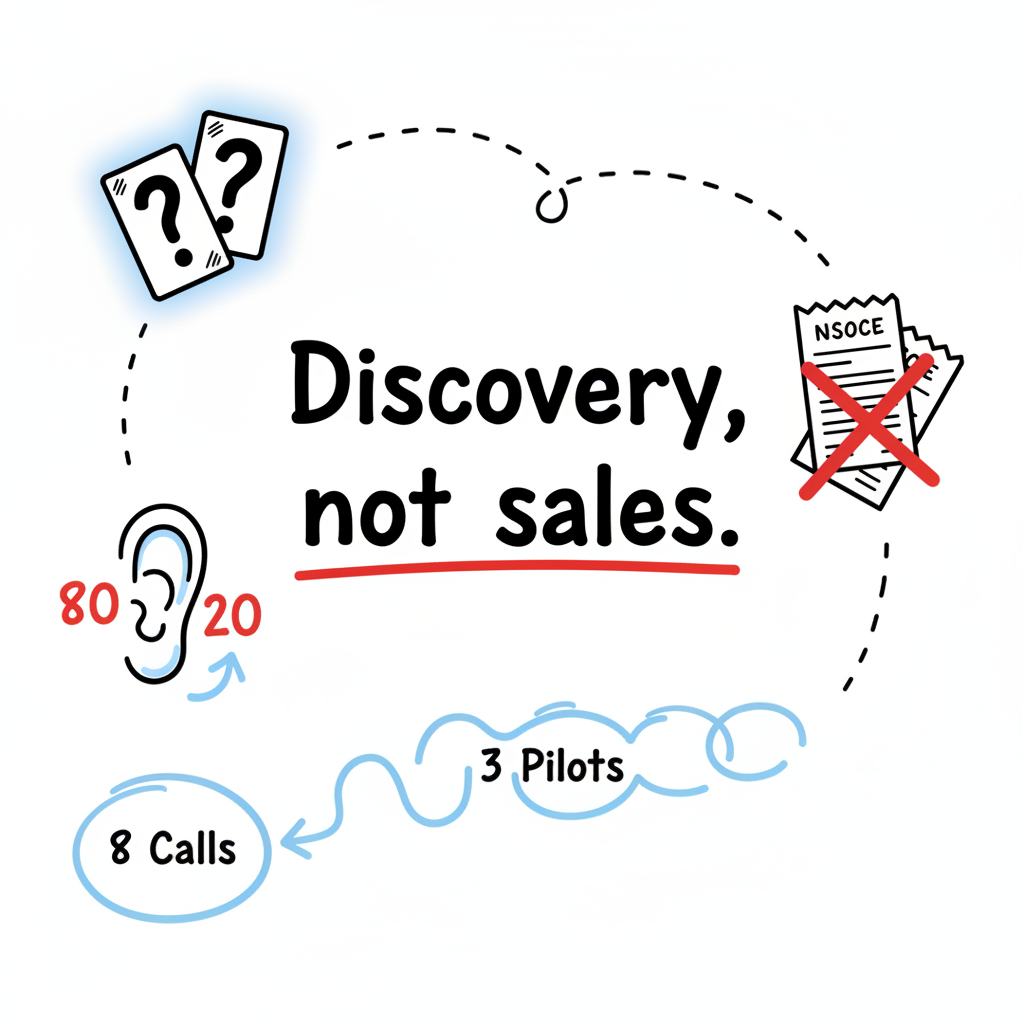
But here’s the secret: early user conversations aren’t sales. They’re discovery. Done right, they don’t feel pushy at all. They feel like curiosity.
This post gives you a founder-friendly playbook: how to talk to users, what to ask, and how to get insights without pitching.
Why User Conversations Matter More Than Features
- MVPs die not because the code breaks, but because nobody cares.
- Talking to 10 real users teaches you more than 6 months of building.
- User discovery is not optional. It’s oxygen.
What you’re hunting: repeated pains, workarounds, and jobs‑to‑be‑done. These become your thin slice - the Day‑14 demo that actually matters.
The Mindset Shift
Stop thinking of it as “sales.” Start thinking of it as:
- Research
- Curiosity
- Problem interviews
Your goal is not to persuade. Your goal is to listen.
Rules of thumb:
- Treat it like field research, not a pitch meeting.
- You’re not promising features; you’re mapping reality.
- You’re testing the problem, not your ego.
The 5 Golden Rules of User Conversations
Don’t pitch. No “let me show you my idea.” Keep your solution in your pocket until the very end (if at all).
Ask about past behavior, not future guesses.
Say: “When was the last time this happened?”
Avoid: “Would you use this?”Go specific.
“Tell me about the last invoice you sent.”
“Walk me through your last onboarding.”Listen 80%, talk 20%.
Silence is a feature. Let them fill it.Always dig deeper.
“Why? Tell me more.”
“What did you try before that?”
“How did you decide?”
Bonus: Ask for artifacts. Screenshots, emails, templates, dashboards - real artifacts beat opinions.
What to Ask (Examples)
- “Tell me about the last time you tried to solve [problem].”
- “What was frustrating about it?”
- “What workarounds did you use?”
- “How much time/money do you spend on this now?”
- “If it disappeared tomorrow, what would happen?”
- “Who else is involved? Who approves? Who blocks?”
- “What does ‘good’ look like to you in this situation?”
Notice: these are not sales pitches. They’re truth‑mining.
Structure a 20‑minute call:
- 2 min: context + permission (“I’m researching, not pitching. OK if I ask specifics?”)
- 12 min: story of the last time (timeline, actors, tools, costs)
- 4 min: quantify the pain (time, money, frequency)
- 2 min: permission to follow up and ask for referrals
How to Recruit Interviewees
- Start with warm intros (friends, ex‑colleagues, LinkedIn contacts).
Ask: “Who do you know who [job/role] that deals with [problem]?” - Offer something small in return (a coffee, a favor, your time).
Consider a $10 gift card if the audience is cold. - Be clear it’s research, not a pitch.
“I won’t sell you anything on this call.”
Where to find them fast:
- Niche Slack/Discord communities, subreddit threads
- Local meetups and coworking spaces
- Customer support forums for tools in your niche
- Your own inbox and calendar - past clients, prospects, or partners
Outbound script you can paste:
“Hey [Name] - quick favor. I’m researching how [persona] handles [problem]. I’m not selling anything; I’m doing 20‑minute calls to map real workflows. If helpful, I’ll share a summary of what I learn. Would you have 20 minutes this week or next?”
What to Do With Insights
After 10 conversations, look for patterns:
- Repeated pains → gold
- Workarounds → demand signal
- “I’d pay for this today” → strongest validation
Turn these into scope cards for your MVP:
- Problem: one sentence
- Thin slice: one happy path you can demo in 14 days
- Acceptance criteria: success test for Day‑14
- Backlog: good ideas that don’t fit Sprint 1
If you’re not hearing repeats by conversation 8–10, your scope is probably too broad. Narrow the persona or the job.
Case Study
I worked with a founder who hated “sales.” We reframed it as interviews.
After 8 calls, she heard the same thing: “I waste 2 hours reconciling invoices.”
That became the MVP core flow → invoice automation.
30 days post‑launch: 3 pilots.
What she did right:
- She asked for the last time, not hypotheticals.
- She requested artifacts (a redacted invoice and the spreadsheet).
- She translated the pain into one measurable outcome for Day‑14.
Common Mistakes (and Fixes)
- Asking leading questions → replace with neutral prompts (“What happened next?”)
- Pitching too early → keep solution talk for the last 2 minutes (if at all)
- Talking to tourists → qualify with “Will you actually try a free demo in two weeks?”
- Skipping notes → record (with permission) and tag themes right after
The Question Bank (Lead Magnet)
To make this easier, I put together a User Interview Question Bank with 20 proven prompts founders can use in discovery calls.
👉 Download it free here.
What’s inside:
- Kickoff scripts for warm and cold intros
- 20 questions mapped to the JTBD timeline (trigger → search → attempt → outcome)
- A 20‑minute call agenda template
- A simple scorecard sheet to spot patterns
Key Takeaway
Early conversations aren’t sales. They’re discovery. Your job is not to pitch. Your job is to listen.
If you do that 10 times with the right people, your MVP scope writes itself.
CTA
Grab the User Interview Question Bank and book a 20‑min scope call to turn insights into a 14‑day MVP.
Visit weekonelabs.com.